Panel: Ontology for Meaning-Driven AI
- Starts at
- Tue, Aug 4, 2026, 11:00 KST
- Finishes at
- Tue, Aug 4, 2026, 13:00 KST
- Venue
- Large Lecture Room
Ontology for Meaning-Driven AI: Grounding, Interpretability, and Trust
Ontologies play a critical role in organizing, connecting, and enabling the reuse of information
across memory institutions and other knowledge domains. As AI systems increasingly generate and consume metadata, ontologies are emerging as essential mechanisms for grounding meaning, supporting interoperability, and building trust. Yet ontology development remains uneven and challenging in AI-enabled environments, requiring new approaches that integrate human expertise, machine reasoning, and scalable workflows. This panel brings together researchers and practitioners to examine how ontology practices are evolving, focusing on design strategies, human–AI collaboration, validation, and the role of ontologies in supporting reliable, interpretable, and reusable knowledge in an AI-driven environment.
-
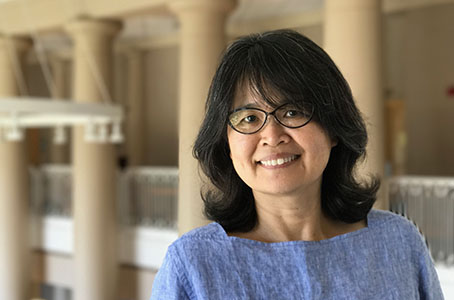
Myung-Ja (MJ) K, Han
Andrew Turyn Processor/Metadata Librarian
University of Illinois Urbana-Champaign
Myung-Ja (MJ) K. Han is the Andrew Turyn Professor and Metadata Librarian at the University of Illinois. Her research focused on digital humanities and metadata studies, with a focus on data interoperability and the use of information technologies. MJ serves on the DataCite Metadata Working Group, the Metadata Object Description Schema (MODS) Editorial Board, and the HathiTrust Program Steering Committee. She previously served as Chair of the Program for Cooperative Cataloging (PCC), an international program that develops and maintains metadata standards adopted by libraries worldwide. -

Sumin Leem
Postdoctoral Associate
University of Calgary
Sumin Leem works on applied AI and ontology-driven workflows at Clause Technology and is a Postdoctoral Associate at the University of Calgary. Her work focuses on evidence-grounded approaches to AI-enabled metadata, interpretation, and decision-assist workflows in policy- and regulation-driven settings. She explores how semantic structures and validation practices can support grounding, interpretability, and trust in AI systems that assist expert decision-making. In industry, she builds traceable LLM/RAG workflows that preserve human judgment and semantic control. -

Josh Falconer
Lead Data Taxonomist & Ontologist
The New York Times
Josh Falconer is the incoming Lead Data Taxonomist & Ontologist at The New York Times. He joins from Bloomberg, where he was Senior Ontologist, modeling events and states for an enterprise knowledge graph, and previously was Ontologist at Indeed. For over a decade, he served in bibliographic metadata cataloging roles focusing on Middle Eastern and North African manuscript collections at HMML and the Library of Congress. His research interests center on knowledge organization systems, event representation, and cross-linguistic typology. He holds an MSLIS from UIUC and is now studying computer science at CU Boulder. -

Inkyung Choi
Assistant Professor
Sungkyunkwan University
Inkyung Choi is an Assistant Professor in the Department of Library and Information Science at Sungkyunkwan University. As a current FAIR Fellow, she specializes in metadata architecture, ontology engineering, and knowledge organization, with a focus on implementing FAIR principles to enhance data interoperability and reuse. Her current research focuses on developing a standard-based Knowledge Graph aiming to transform fragmented domain information into sustainable, machine-actionable knowledge infrastructures for AI-driven scientific discovery.

Hosted by